The wall behind a hob takes more punishment than any other surface in the kitchen. It catches spitting oil, steam, tomato sauce, splashes of stock and the occasional over-enthusiastic whisk. It also sits exactly where your eye lands every time you walk in the door. So when people ask whether to use natural stone or tiles for a splashback, the honest answer is that both work well — they simply work differently, and those differences show up in your budget, your cleaning routine and how the finished room feels.
What follows is a practical side-by-side for UK kitchens, covering cost, grout lines, upkeep, heat and visual impact.
First, a useful clarification
Natural stone splashbacks usually mean a slab: one piece of granite, marble, quartzite, slate or limestone cut to fit the space, generally 20mm thick and often matched to the worktop. Tiles are ceramic or porcelain, usually 6–10mm thick, set in a grid. Engineered quartz sits somewhere between the two — it comes in slabs like stone, but it is a manufactured material rather than a quarried one.
Stone also comes as tiles, of course, and porcelain now comes in very large formats that look like marble. So the real comparison is less "stone versus tile" and more "a few large pieces versus many small ones". That single distinction explains most of what follows.
Cost: where the money actually goes
Per square metre, ceramic and porcelain tiles are almost always cheaper than a natural stone slab. But the total bill is decided by labour and complexity, not the material alone.
Tiles mean paying for tiles, adhesive, grout, trim and a tiler's time. Small formats require more cutting around sockets and more grout to run, so a fiddly layout can quietly eat the savings. If your walls are not flat — common in older British homes — add prep work.
Stone means paying for the slab or offcut, templating, cutting, polishing, edge finishing and often a two-person install. A 20mm slab is heavy and cannot simply be stuck to plasterboard; the substrate and fixing method need thought, and that costs money.
Two ways to keep stone affordable. First, ask your fabricator whether there are offcuts from a recent worktop job in a colour you like. Second, keep the shape simple: one rectangle with a single socket cut-out is far cheaper than a design with eight cut-outs and mitred returns.
Grout lines: the difference you notice daily
Grout is where tiled splashbacks earn their keep and where they eventually disappoint. A tiled wall behind a hob collects a fine film of grease in every joint. Stone slabs, by contrast, give you one continuous surface with joints only at the corners and edges, sealed with silicone rather than grout.
If you go tiled, three decisions determine how the grout ages:
- Width. Wide joints show dirt more readily. Narrow joints look sharper but leave less room for movement.
- Colour. Mid-tones hide staining better than bright white, which shows every splash of turmeric and tomato.
- Type. Cement-based grout is easy to work with but porous. Epoxy grout resists staining and grease far better, though it is harder to apply and less forgiving of an inexperienced hand.
Even with epoxy, you will be cleaning joints. With a slab, there are no joints to clean beyond the silicone line at the bottom.
Cleaning and upkeep through the year
Porcelain is close to bombproof: a warm damp cloth and a mild detergent does nearly everything. Ceramic is similar, though a glazed surface can chip at an exposed edge.
Natural stone needs a little more thought. Granite, quartzite and slate are dense and forgiving. Marble and limestone are softer and will etch if lemon juice, vinegar or tomato sits on them, leaving a dull mark that no amount of scrubbing removes. Sealing helps but is not a permanent shield, and porous stones benefit from re-sealing periodically depending on use.
A simple routine that keeps both options looking well:
- Wipe the splashback after cooking rather than at the end of the week.
- Use a pH-neutral cleaner on stone; avoid acidic sprays and cream abrasives.
- Blot spills rather than wiping them across the surface.
- Check the silicone bead behind the worktop once a year and replace it if it has gone black or lifted.
Heat, the hob zone and installation
Porcelain and ceramic cope well with everyday kitchen heat. Natural stone varies: granite and slate are generally robust, while some stones can be affected by very localised heat or sudden temperature changes. A splashback directly behind a gas hob deserves particular care.
Check the hob manufacturer's clearance guidance before you commit to a material, and follow it. Gas appliance work should be carried out by a Gas Safe registered engineer. If you are unsure how a specific stone behaves near a hob, ask the fabricator who supplies it — they see the failures and know which stones to avoid in that position.
Visual impact: calm or rhythm
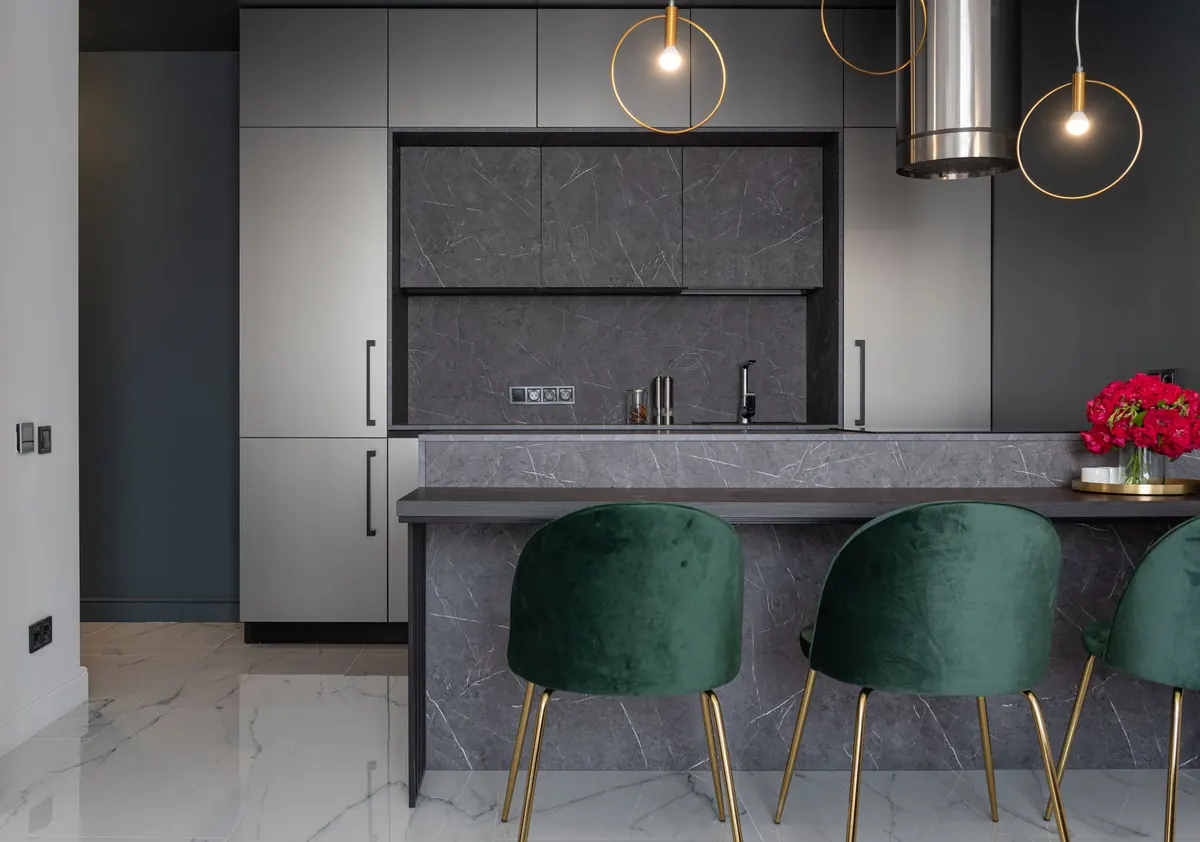
A stone slab reads as one continuous surface. Veining flows uninterrupted across the wall, and in a small kitchen this calm expanse can make the room feel larger and more considered. Matching the splashback to the worktop creates a seamless block of colour; choosing a contrast adds depth.
Tiles bring rhythm. Metro bricks, hexagons, handmade zellige and large-format porcelain all behave differently, and the grout pattern becomes part of the design rather than something to hide. Tiles also let you change colour easily and use leftover boxes for repairs. Stone is harder to patch, so order spare material and keep it.
Five questions that settle it
- How much frying, simmering and tomato-based cooking happens on this hob?
- Do you already have a worktop material you would like to match, or an offcut you could reuse?
- Are the walls flat and the substrate strong enough for a heavy slab?
- Do you want the splashback to disappear into the room, or to be the feature?
- How often are you realistically going to clean it?
A practical way to decide
If you cook often with oil and strong sauces and want the simplest possible upkeep, porcelain or a hard, well-sealed stone such as granite or quartzite is the sensible choice. Choose marble only if you like the idea of a surface that ages and marks with use, because it will.
If you want a quiet, uninterrupted wall that ties the kitchen together, go for stone and accept the higher upfront cost. If you want pattern, colour and a lower entry point, go for tiles and spend the saving on good grout and a careful tiler.
Either way, do two things before ordering: take a sample home and look at it in your own kitchen light, and get quotes from two installers so you can compare what is actually included. Templating, sealing, silicone and removal of the old surface are the items that most often appear as extras halfway through a job.
Photo: Max Vakhtbovych / Pexels